The Clawback: Building ClawOps Around OpenClaw
The story behind ClawOps: how losing capital at INDX, the rise of OpenClaw, and years at the AI/crypto intersection led to managed personal AI assistant hosting.
By now, most people in the tech space know the OpenClaw story. An open-source personal AI project explodes in popularity, Anthropic sends legal threats, names change, and eventually the whole thing ends in an Open AI acquisition. Theo does a great breakdown if you want the full arc, but the story is just as much about Peter Steinberger, the creator, as it is the project itself.
What Peter represents is something we find genuinely exciting: what happens when someone with deep, real technical experience fully embraces modern AI tooling. Not a surface-level user. Not someone who discovered LLMs six months ago. Someone who understood the stack well enough to move fast, build decisively, and ship something that resonated with hundreds of thousands of people.
That framing matters, because it’s central to what we’re doing.
Closing a Chapter
Before we get into ClawOps, some context.
I was co-founder at INDX. Late last year, we lost our capital funding. It happens, especially in the current environment. We had to go back to basics and reassess.
INDX was a crypto currency trading platform that allowed users to buy multiple tokens in a single transaction, no proxies, no synthetic assets. I still truly believe in the tech and the concept. That chapter isn’t closed forever.
What we didn’t do is stop building.
The Moment Everything Connected
Here’s what’s interesting about the timing. Right as INDX was going through its internal changes, my co-founder and I were already deep in research around multi-channel bots for agentic trading, systems that could use persistent knowledge and memory to operate across platforms and make informed decisions autonomously.
When the first version of Clawdbot OpenClaw dropped, the synergy was immediate and obvious.
Between us we’ve got decades of skin in the game, engineering enterprise software, web3, crypto markets. We aren’t hitching onto a hype cycle. We were already here.
So we leaned in.
The initial goal was to use OpenClaw to accelerate our trading solution (still in alpha). But as we started mapping out the infrastructure we’d need: auto-provisioning agents, secure hosting, immediate user access, removing API key friction, keeping costs genuinely affordable, we realised we were building something that had value far beyond our own use case.
That underlying infrastructure became ClawOps.
What ClawOps Actually Is
Let’s address the obvious thing first.
Yes, there’s a new one-click OpenClaw deploy tool every week. We’ve seen them. Most are a Bash script, a landing page, and a subscription. That’s not what this is.
ClawOps is managed hosting and deployment for OpenClaw agents, but the hosting is the foundation, not the product. It’s the infrastructure layer that makes everything else possible.
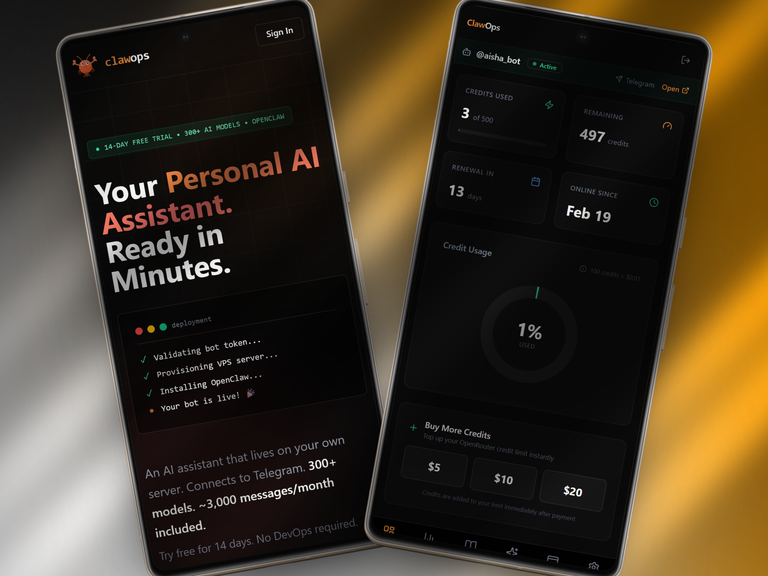
The setup genuinely takes about 5 minutes. You sign up, your VPS is provisioned, OpenClaw is installed and configured, sensible default models are set up, automatic document indexing is enabled, and your assistant is live on Telegram. No API keys to manage. No model selection paralysis. No DevOps. It just works.
And yes, the token efficiency matters too, out of the box, ClawOps instances use roughly 70% less tokens than a standard setup by searching memory and documents locally before calling a model. That’s what lets us price this closer to a Netflix subscription than an enterprise software bill.
But again, that’s the foundation.
Companions: This Is Where It Gets Interesting
The real product is what we call Companions.
A Companion is not a generic AI agent. It’s not a markdown file with a system prompt and a personality bolted on. Anyone can publish one of those to a skills directory and call it a product.
A ClawOps Companion is a purpose-built specialist assistant, a fully pre-configured domain expert with real workflow logic, structured data storage, intelligent memory, and curated knowledge baked in from day one. You install it and it already knows what it’s doing, why it’s doing it, and how to get better at it over time through your interactions.
Think of it less like a skill and more like hiring a specialist who already knows the job.
Meet Entertainment Buddy
Our first Companion is live: Entertainment Buddy.
On the surface it sounds simple, a tracker and recommendation engine for movies, shows, and what to watch next. But the implementation is what we’re proud of.
When you first interact with Entertainment Buddy, it doesn’t dump a configuration screen on you. It has a conversation. It asks what you’ve been watching. It picks up on your preferences naturally. It builds a structured picture of your taste across genres, platforms, and moods, stored in a way it can actually reference and reason over, not just vaguely “remember.”
Ask it what to watch on a Friday night when you’re tired and want something easy, and it doesn’t give you a generic top 10 list. It knows you’ve already seen those. It knows you tend to fall asleep during slow burns after 9pm. It suggests something specific, and it tells you why.
That’s a small example of a much bigger point: this is what an AI assistant should actually feel like. Not a chatbot with a theme. A specialist that knows its domain, remembers your context, and gets genuinely more useful over time.
What’s Coming
Entertainment Buddy is the proof of concept. It demonstrates the platform architecture and the Companion model works.
But the Companion we’ve been building for months, the one my business partner, a genuine crypto expert, has been driving, that’s a different conversation entirely. More on that very soon.
In the meantime, the base is live. 14-day free trial. Telegram bot running in 5 minutes. No immediate cost, no API key setup, no DevOps.
Start your free trial at clawops.io →
We’re just getting started on the capabilities layer. Watch this space.
Questions? Find us on Twitter/X.